EngineAI introduces Awaken-HI for humanoid training
EngineAI researchers introduced Awaken-HI, a vision-language-action model pretrained on a claimed 50,000 hours of synchronized human video and motion. The opened sources did not include an independent reproduction of the authors' scaling and robot-task results.
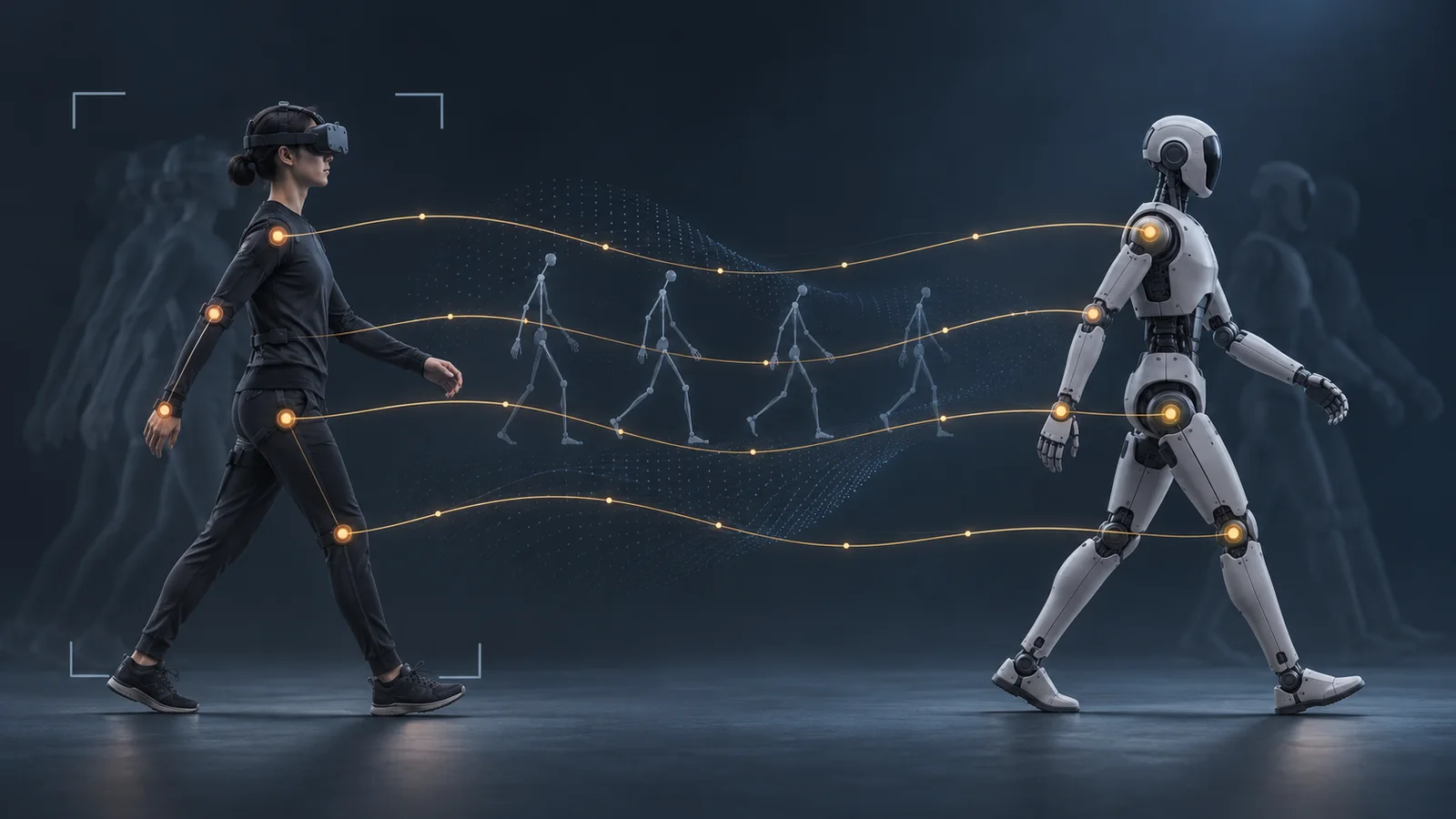
EngineAI researchers introduced Awaken-HI, a vision-language-action model that they say learns humanoid control from roughly 50,000 hours of synchronized first-person video and whole-body human motion. The Awaken-HI technical report was submitted to arXiv on November 19.
The authors report that the resulting model averaged 93.75% success across eight individual tasks on EngineAI’s T800 humanoid, compared with 57.5% for pi-0.5 and 58.75% for GR00T N1.7. Those results came from EngineAI’s own setup, using 10 trials per task; the opened sources did not include an independent reproduction.
The training corpus, called Awaken-Human, is described as 17.02 million episodes spanning more than 100 skills, with 5.41 billion pose frames and 11.18 million valid language instructions. EngineAI says people recorded demonstrations with a PICO headset and five body-worn trackers in homes, workplaces, shops and storage areas. Its pipeline reconstructs 3D hand motion, assigns human-reviewed subtask labels, estimates stereo depth and filters low-quality segments.
Awaken-HI uses Qwen3-VL as its vision-language backbone. A shared action component learns from original human motion, actions retargeted to the T800 body and wrist poses expressed relative to the camera. In deployment, the robot branch converts a head-camera image, an instruction and the robot’s current joint state into sequences of 40-dimensional whole-body targets for the controller. The authors say a T800-specific retargeting process reduced mean end-effector position error from 16.423 centimeters to 2.422 centimeters relative to their implementation of GMR.
To test scaling, the researchers trained on nested subsets of 5,000, 12,500, 25,000 and 50,000 hours, then evaluated matched checkpoints on the same 100-hour held-out set. They report that increasing the pretraining set from 5,000 to 50,000 hours lowered normalized-action inference error by about 11% and validation loss by 18.8%. After the same robot post-training stage, mean success across three household tasks rose from 56.7% to 90.0%, according to the paper.
For the main robot comparison, the team post-trained each policy with about 150 hours of synchronized T800 teleoperation data. Beyond the eight individual tasks, the authors report 90% success on a four-stage industrial stocking sequence and 80% on a three-stage household tidying sequence. Long-horizon success required every stage to finish without resetting the robot or scene.
The public materials do not yet permit reproduction of the headline results. The Awaken-HI repository lists the report and dataset as released but says inference code, model weights and the simulation platform are still forthcoming. The paper supplies no confidence intervals for its 10-trial task evaluations, where each outcome changes a task score by 10 percentage points.
More news
PhyDEX paper puts three VLA models below 3% success
HumanCOIN adds gaze, EMG and EEG proxies to 12,500-hour dataset
Researchers train VLA robot policies to stop safely mid-task