Google scales quantum contextuality benchmark to 105 qubits
Google Quantum AI ran contextuality benchmarks on superconducting processors with up to 105 qubits, exposing hardware errors without showing practical quantum advantage.
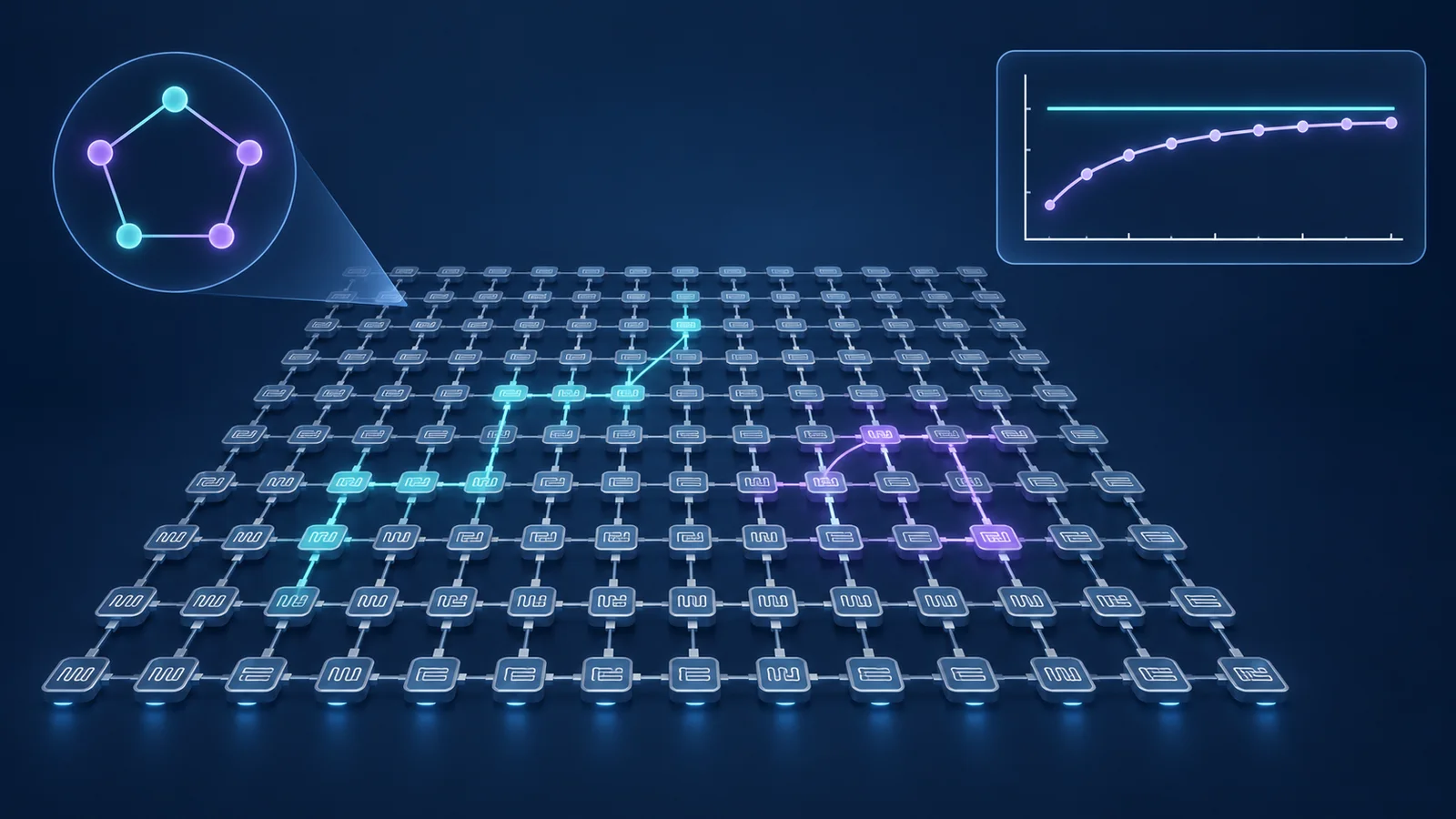
Google Quantum AI and academic collaborators turned contextuality experiments on superconducting processors with as many as 105 qubits into fixed-score hardware tests. The results exposed errors without demonstrating a practical quantum-computing advantage.
The experiments described by Google Research combine tasks with classical and quantum limits set by physics with a hidden-linear-function comparison whose finite-size classical bound is conjectured. For the fixed-limit tasks, engineers have a target: the distance between a processor’s measured score and the ideal quantum result captures errors accumulated during state preparation, gates and readout. Google said the work was published in Science after an earlier research preprint.
The smallest test was a four-qubit implementation of the Mermin-Peres magic-square game using two shared Bell pairs and compatible preset measurements. The team ran each of nine row-column assignments 100,000 times and measured an average win probability of 0.9830, with a stated uncertainty of 0.0001. That exceeded the optimal classical limit of 8/9 but remained below the perfect score available to an ideal, noiseless quantum strategy.
This gap makes the game a compact diagnostic. A processor must preserve the correlations needed to satisfy the game’s constraints, so preparation, gate or measurement faults reduce its win rate. The test is not an application workload; it measures how closely hardware implements a known quantum strategy.
The researchers also ran a sequential contextuality-inequality test on two system qubits, using an ancilla qubit for quantum non-demolition measurements. They randomly selected 180 contexts, performed 540 measurements in each circuit and repeated the sequence 1,000 times. Because the inequality has a noncontextual bound and a fixed quantum ceiling, the measured score offers another hardware reference point. Google’s post and the first arXiv version report different numerical scores for this test, so neither value is used here.
At a larger scale, the team ran an N-player GHZ parity game with up to 71 qubits. It reported win probabilities above the applicable classical strategy at every tested size, although the margin narrowed as the number of qubits increased. The researchers also reported genuine entanglement across 45 qubits without readout-error mitigation, a result separately described in an American Physical Society meeting abstract.
The largest experiment applied a two-dimensional hidden-linear-function task to systems ranging from 9 to 105 qubits. At each size, the researchers sampled 1,000 matrix instances and ran every instance 100 times. After initialization, each circuit began with a Hadamard layer, then applied one layer of S gates, four layers of controlled-Z gates and final Hadamards before measurement. Google said the success probability declined to about 0.6 at 105 qubits.
The preprint translates the observed noise into an effective circuit depth of about six, compared with the four physical controlled-Z layers. It also says the structured tasks exposed coherent errors that random-unitary or random-circuit tests can average away, supporting the authors’ proposal to use them as sensitive hardware-development benchmarks. The experimental outcomes were checked with classical Clifford simulation.
The result does not establish an unconditional general quantum-computing advantage. The rigorous separation for the hidden-linear-function problem applies asymptotically, while the comparison at the tested processor sizes relies on a conjectured finite-size classical-depth bound. The opened evidence also provides no end-to-end wall-clock, energy or cost comparison with conventional computing and demonstrates no chemistry, materials-science or other commercial workload.
More news
IBM reports quantum-HPC workflow results at SC26
NVIDIA, IBM and Fermilab plan modular quantum-classical platform
Q-CTRL raises $290 million in Salesforce Ventures-led Series C