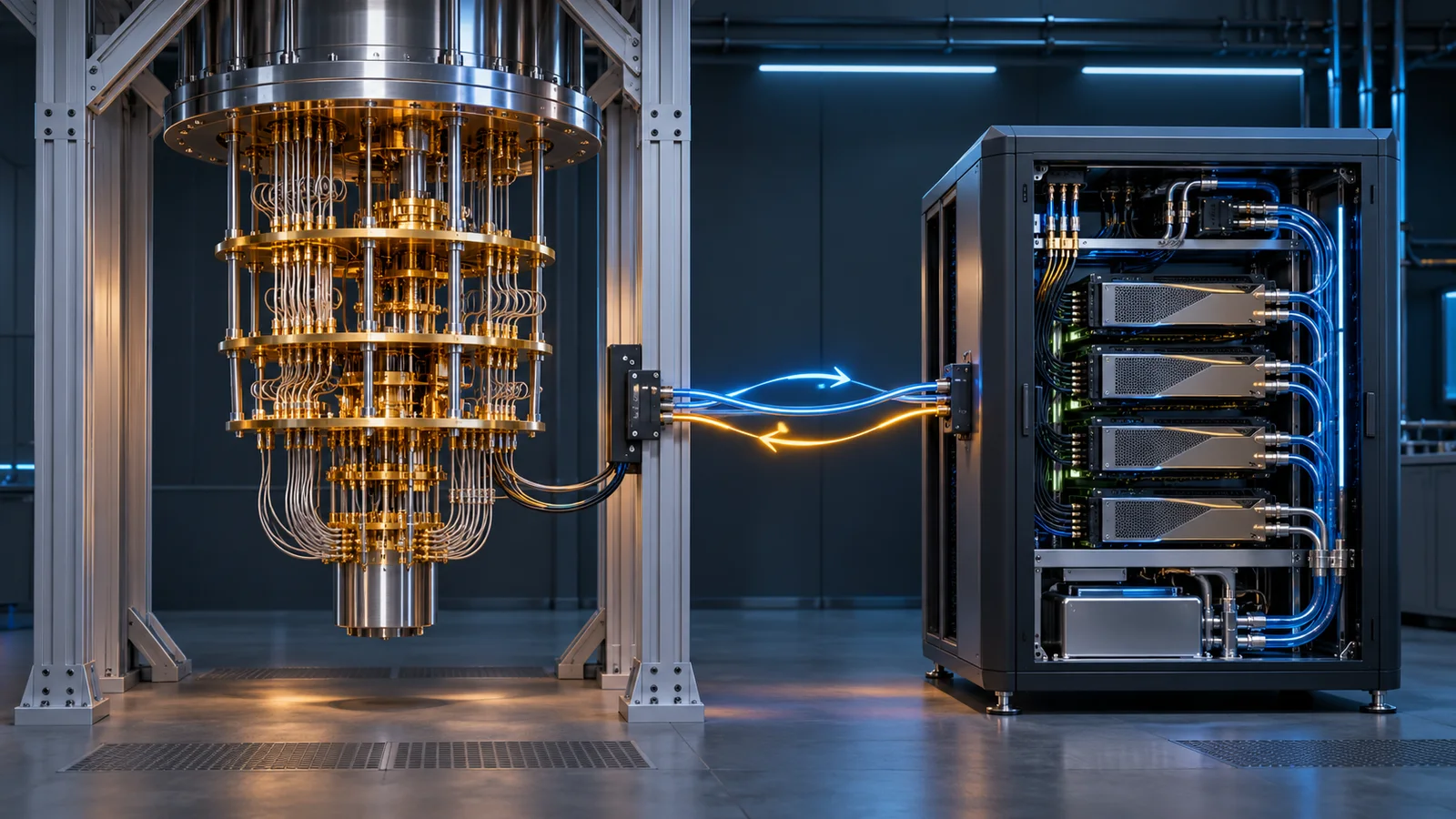
IBM reports quantum-HPC workflow results at SC26
IBM reported an iron–sulfur-cluster calculation that spanned quantum and GPU systems, plus a separate DeltaAI workflow linked to IBM Quantum System Two.

IBM reported two quantum-HPC workflow results at SC26: an iron–sulfur-cluster calculation run across quantum and GPU systems, and a separate University of Illinois, NCSA and IBM workflow connecting NCSA’s DeltaAI supercomputer with IBM quantum hardware.
In the iron–sulfur work, the reported energy came in 4.3 millihartree above a classical comparison value. The Illinois team used its combined system to model Cu₃C₆O₆, a quantum material, but IBM did not disclose a numerical accuracy result or comparative performance benchmark for that workflow.
The researchers’ preprint describes the iron–sulfur calculation as a [Fe₄S₄(SCH₃)₄]²⁻ cubane model with 54 electrons, 36 orbitals, 72 data qubits and 88 total qubits. The researchers adapted a sample-based quantum diagonalization, or SQD, workflow to begin from a broken-symmetry unrestricted Hartree–Fock reference, a starting approximation designed to represent the cluster’s magnetic interactions before quantum samples are processed.
The workflow then ran multistep configuration recovery on ROQUO GPU nodes. The preprint reports an SQD energy of −327.235076 hartree, 4.3 millihartree above its finite-D=4000 density-matrix renormalization group comparison of −327.2393952 hartree. IBM says that gap was 79 times closer than the team’s earlier closed-loop SQD result on the same cluster. The paper is a preprint, and the opened sources did not establish peer review.
Work on the Illinois result followed a collaboration expansion announced in April, when IBM and the University of Illinois said they planned to integrate NCSA’s Delta and DeltaAI systems with IBM quantum computers. IBM says the University of Illinois, NCSA and IBM connected DeltaAI to an IBM quantum computer within six months and used the combined system for the Cu₃C₆O₆ model.
NCSA describes the workflow as running sample-based Krylov quantum diagonalization on IBM Quantum System Two to identify relevant electronic subspaces. DeltaAI’s GPUs then perform exact diagonalizations on the reduced subspace problems, and the output feeds into a dynamical mean-field theory workflow. That method targets a quantum-impurity calculation that becomes increasingly costly on classical computers as the modeled system grows.
NCSA scheduled live demonstrations of the DeltaAI and IBM Quantum System Two workflow for November 17, 18 and 19 at SC26, including a step-by-step execution and live performance metrics. Other items in IBM’s SC26 post — including Fermilab, Oak Ridge National Laboratory, Pelagos and workflow-management tooling — are outside these two results.
More news
NVIDIA, IBM and Fermilab plan modular quantum-classical platform

IBM adds Qiskit tools and managed workflows at QDC 2026
IBM makes Quantum System Two operational in Chicago