IBM links two Nighthawk quantum processors with four meter-scale L-couplers
IBM researchers connected two 120-qubit Nighthawk processors using four cable-based L-couplers, reporting state transfers and entangling operations across the modular links. The experiment remains separate from IBM's planned Starling system.
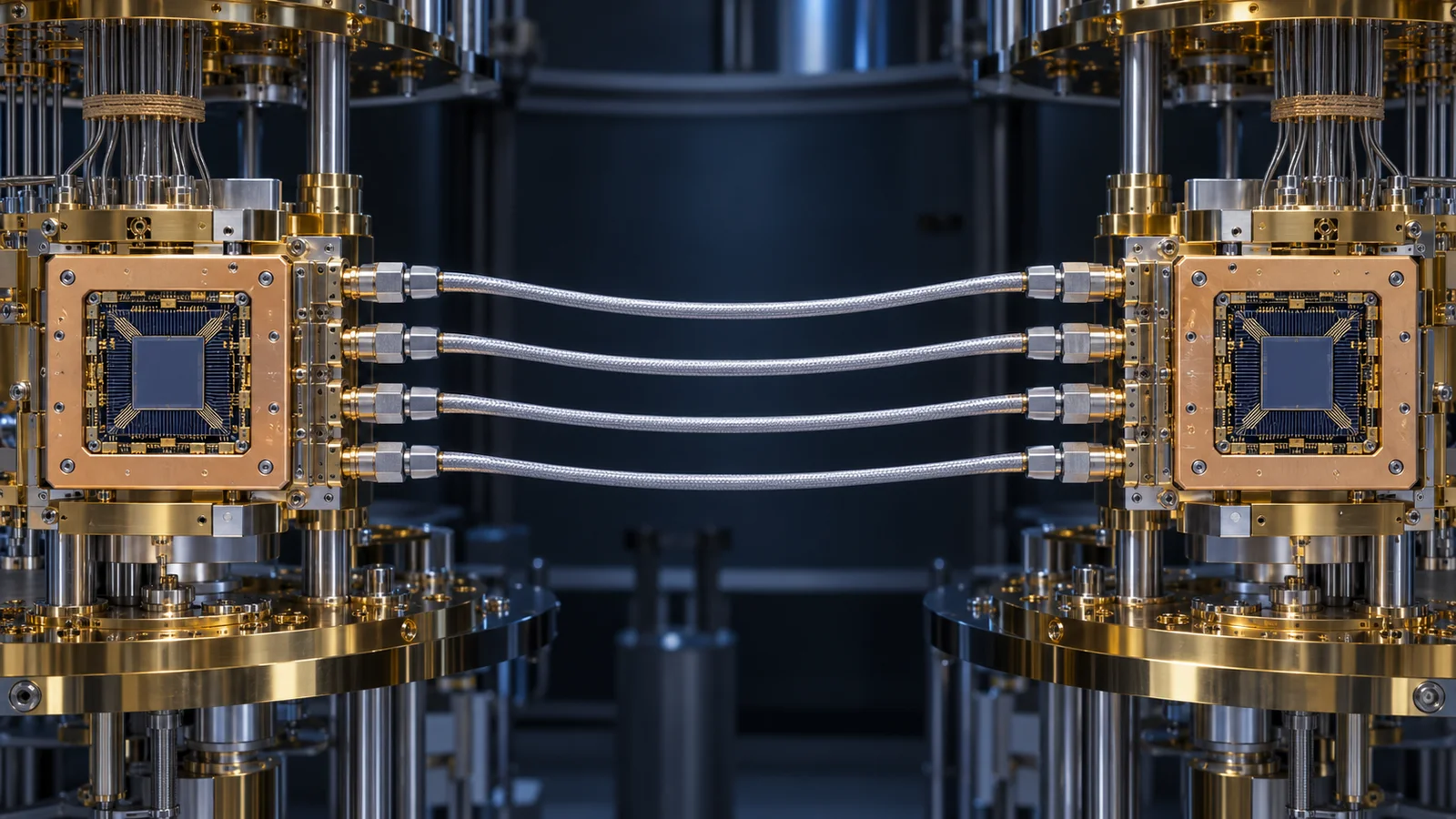
IBM researchers connected two 120-qubit Nighthawk R1 superconducting processors with four meter-scale L-couplers, creating multiple channels for quantum operations across separate chips. According to an IBM-authored preprint, the test demonstrates a modular interconnect on full processor chips, though the setup used reduced wiring and measured only the qubits around the links.
Each L-coupler joined ordinary processor qubits through two dedicated, frequency-tunable L-qubits, two tunable couplers derived from RF SQUIDs, on-chip routing and roughly 80 centimeters of superconducting aluminum coaxial cable. The design keeps dense connections within each processor while using fewer cross-module edges to transfer quantum states and support entangling gates between chips.
To increase packing density, the team installed the cables perpendicular to the processor surfaces. Indium pressure bonds attached the cables after both modules were mounted in the cryostat, while a spring-loaded holder made two connections at a time.
In two-way network tests, relay-based state-transfer fidelity reached at least 98.86% on every link. The paper reports a 99.00% mean and a best result of 99.29% plus or minus 0.07%. A controlled-Z gate spanning the processors averaged 94.75% fidelity, with a best result of 96.42% plus or minus 0.28%. The researchers also generated Bell pairs and four- and six-qubit GHZ states across the modules. All reported unmitigated state fidelities cleared the paper’s 50% threshold for certifying entanglement.
All four links remained operational through three thermal cycles without their connections being disturbed. The experiment did not test disconnecting and remating a cable. The paper also found that magnetic field present as the aluminum cable crossed its superconducting transition reduced cable quality. Two layers of magnetic-shielding braid mitigated the loss, although the authors called the arrangement temporary and said the underlying loss mechanism remained unresolved.
The demonstration is not IBM Quantum Starling. IBM describes Starling as a planned fault-tolerant system for 2029 that would connect multiple modules and run 100 million quantum gates on 200 logical qubits. IBM separately states that its quantum roadmap reflects current intent and may change or be withdrawn. Those Starling figures remain targets, not results from the two-Nighthawk experiment.
More news
IBM says DARPA moved its quantum computing plan to Stage C

IBM brings native Qiskit development to Fortran, C++ and Julia
IBM researchers prove theoretical quantum advantages over bounded language models