IBM researchers prove theoretical quantum advantages over bounded language models
IBM researchers proved two asymptotic separations in which shallow quantum circuits outperform restricted transformer and diffusion language-model architectures, without claiming an advantage on current hardware.
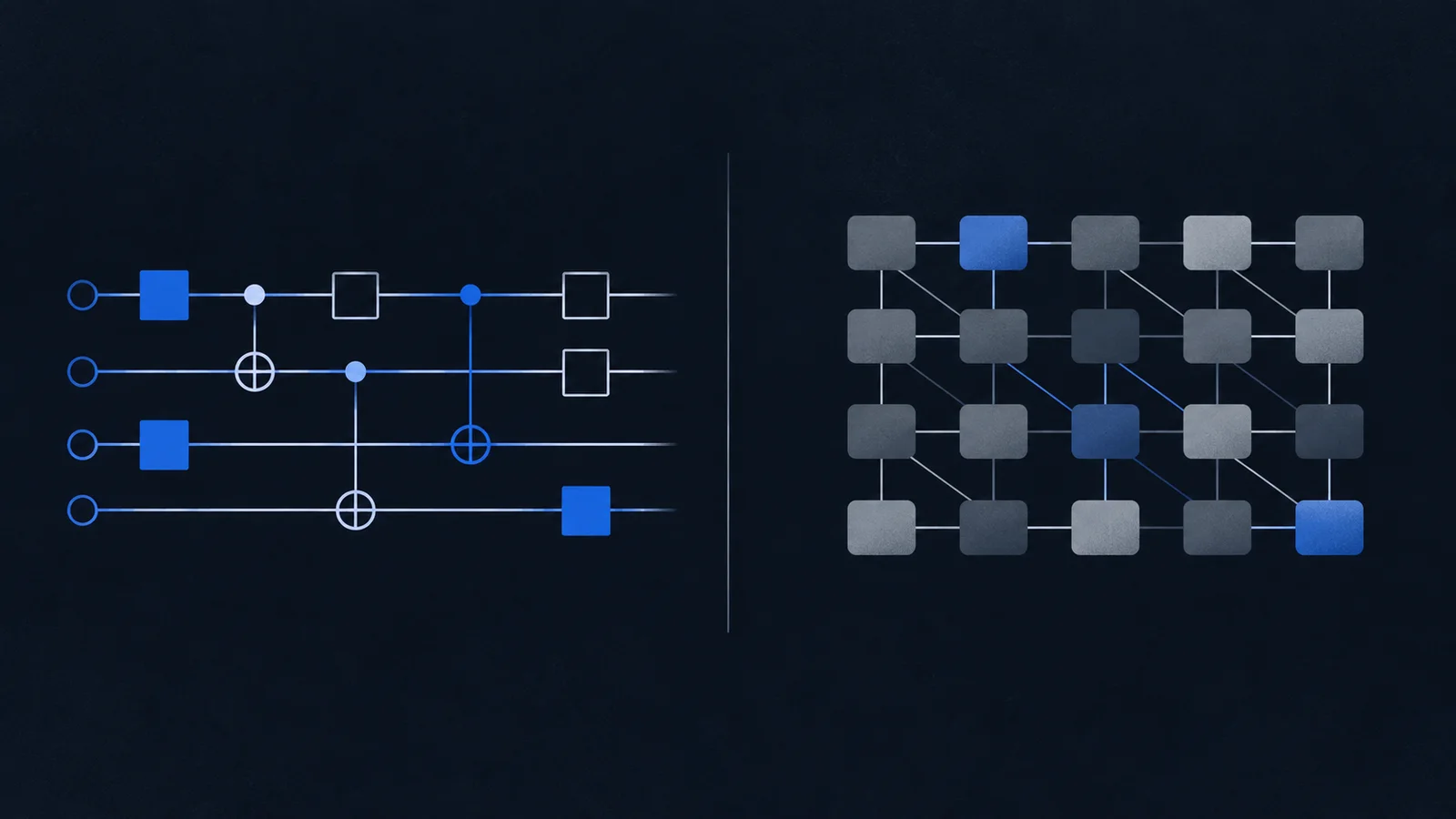
IBM researchers have published mathematical proofs of problems for which specified shallow quantum circuits have an asymptotic advantage over bounded transformer and diffusion language-model architectures. The immediate result is a pair of formal limits for those restricted architectures, not evidence that quantum computers outperform today’s production AI systems.
The 60-page paper, posted in its first version on Aug. 4, presents two unconditional separations within defined computational models. One concerns computing a function with a decoder-only transformer; the other concerns sampling a probability distribution with a diffusion language model. The work reports no experiment on quantum hardware and no benchmark against a production large language model.
For the functional problem, the authors construct an iterated multi-index function that can be computed by a bounded-fan-in quantum circuit of O(log log n) depth followed by one classical AND gate. They prove that a constant-depth decoder-only transformer computing the same function needs width of n^{Omega(1)}. In the paper’s model, width is the product of the number of attention heads, embedding dimension and numerical precision.
That lower bound applies to the paper’s constant-depth decoder-only model. It does not show that arbitrary transformers or deployed LLM systems cannot compute the function.
For the sampling problem, the researchers define a block-parity distribution that a constant-depth QNC^0 quantum circuit can sample. Their classical lower bound covers constant-round diffusion language models whose scheduling and denoising components are polynomial-size, constant-depth GC^0[log n] circuits. It also assumes sublinear workspace or chain-of-thought and a sublinear number of output-token revisions or remasking events. Models within those bounds cannot sample the target distribution within a fixed constant total-variation distance.
The sampling theorem does not cover unrestricted diffusion language models. The authors say their lower bounds do not hold without the stated resource restrictions and that the problems could be easier for classical language models given more chain-of-thought.
In its research explainer, IBM said the proofs establish an asymptotic advantage under a direct formal comparison but do not identify the input scale at which a quantum system would pull ahead. IBM also described current quantum computers as smaller, noisy and error-prone, while today’s LLMs run on larger and more mature classical systems. For context on IBM’s separate hardware-access work, DataPhoenix has covered its Swiss quantum innovation hub at ETH Zurich.
The paper says that an unconditional, non-oracular separation between fully general efficient quantum and classical computation remains beyond current techniques. The research record reviewed for this story is arXiv version 1; the supplied sources include no peer-reviewed publication, independent replication, finite crossover estimate, hardware configuration, error-correction requirement, runtime or cost.
More news
IBM says DARPA moved its quantum computing plan to Stage C
IBM brings native Qiskit development to Fortran, C++ and Julia
IBM says joint team reached 2026 Gordon Bell Prize finals