OpenAI releases cross-country data on ChatGPT work use
OpenAI's Signals dataset charts work-related consumer ChatGPT messages across 165 activities in nearly 100 countries, but leaves out enterprise and Codex use.
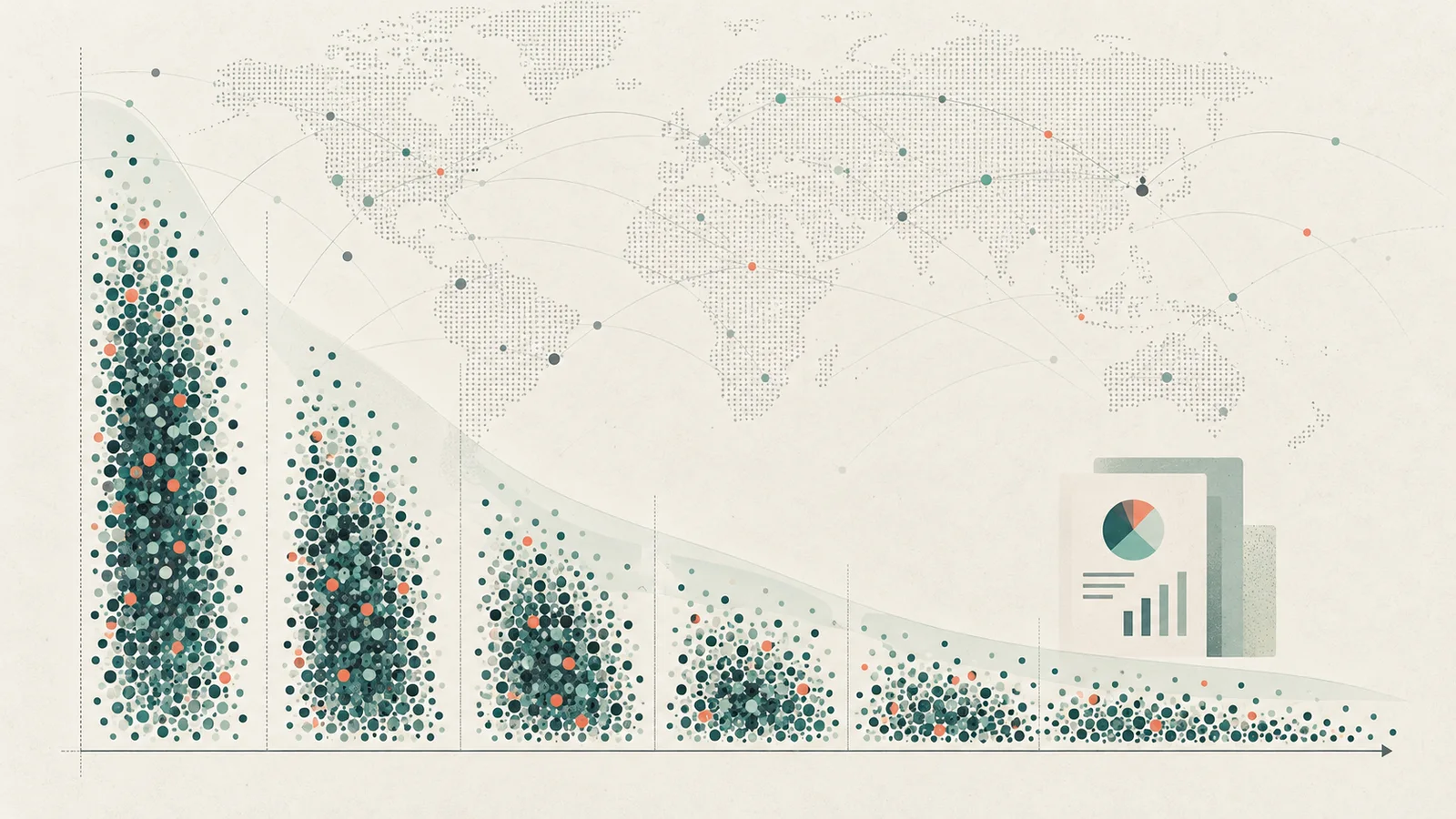
OpenAI released a public dataset mapping work-related consumer ChatGPT messages to 165 activity categories across nearly 100 countries. The quarterly series shows how that use changed from early 2025 through the third quarter of 2026.
In its release, OpenAI said the 10 most common activities accounted for an average 51.1% of each country’s classified work messages in the third quarter of 2026 among 74 countries observed in every quarter. That share was 56.0% in the first quarter of 2025, a shift the company described as work-related use becoming less concentrated in the most common activities. The figures are OpenAI’s calculations and were not independently recomputed from the downloadable data.
The country-level series is part of OpenAI Signals. It uses Intermediate Work Activities from the O*NET Content Model, which organizes work activities at general, intermediate and detailed levels across occupations. The release covers quarterly data from the first quarter of 2025 through the third quarter of 2026.
The scope is narrower than total workplace ChatGPT use. The Signals individual-data page says the dataset covers Free, Go, Plus and Pro accounts, which are generally managed by individuals. It excludes enterprise messages and Codex use, so it does not measure enterprise ChatGPT Work deployments. OpenAI says those exclusions likely underrepresent business and technical use cases.
The broader Signals sample contains 1 million consumer messages per month from July 2024 through September 2026. It is limited to accounts with a declared age of at least 18 and excludes deleted accounts and users who opted out of training use.
The activity labels are model inferences, not users’ descriptions of their work. OpenAI’s Version 3.0 methodology says LLM-based classifiers automatically assign work-relatedness and O*NET activity labels. Researchers did not view raw message text. Instead, the classifiers operated on de-identified data scrubbed of personally identifying information.
OpenAI applies differential-privacy techniques, including calibrated Gaussian noise, before releasing aggregated shares. That makes the results privacy-protected estimates rather than unaltered message counts. Series cells are withheld unless their effective count after weighting and privacy noise reaches 100 messages. The country-quarter O*NET activity table uses a higher minimum of 1,000 because it contains many categories.
Version 3.0 added data for July through September 2026 and increased the sample for earlier periods from 300,000 to 1 million messages per month. OpenAI restated those periods using the larger sample. The methodology does not provide uncertainty intervals for the reported change from 56.0% to 51.1%.
More news

OpenAI study finds workers repeat ChatGPT tasks tied to other occupations

OpenAI reports 130,000 ChatGPT users and 95,000-plus Codex users at Oracle
Stack Overflow says ChatGPT plugin tripled agent signups