Google Research releases MAPL-EMIT system for mapping methane plumes
Google Research released MAPL-EMIT, a vision-transformer system that detects, quantifies and locates methane plumes in NASA EMIT hyperspectral data, together with a global plume database, trained model, synthetic training dataset and inference library.
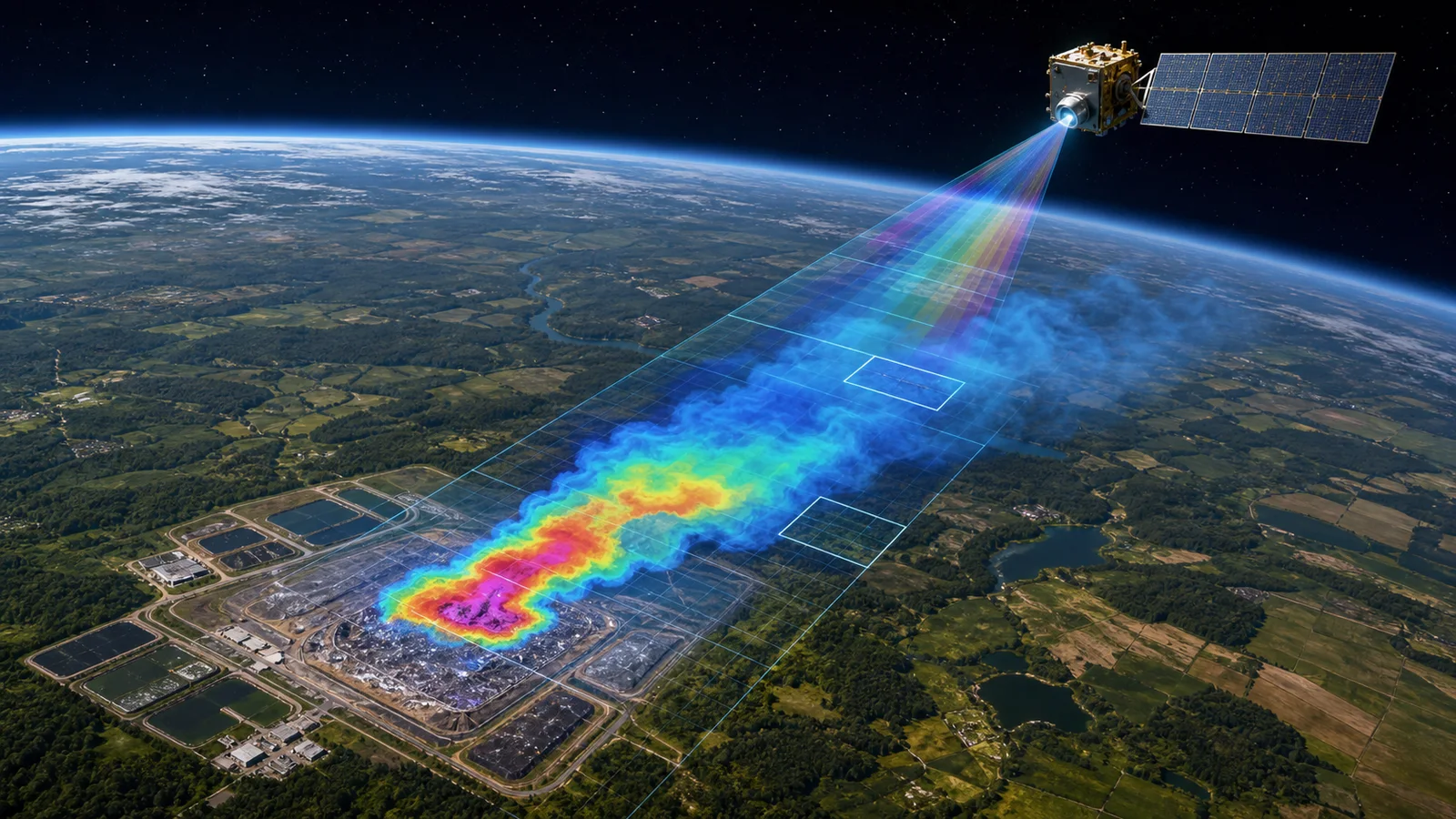
Google Research released MAPL-EMIT on September 1, introducing a deep-learning system that detects, quantifies and locates methane plumes in hyperspectral observations from NASA’s EMIT instrument. The package includes a global plume database on Google Earth Engine, a trained model, a synthetic training dataset and an inference library.
Google reports that MAPL-EMIT captured 84% of expert-annotated plumes and found around 50% more plausible plumes across approximately 1,100 EMIT granules. The company also says the system mapped plumes at 24 of the world’s 25 top-emitting landfills. The released material contains no independent evaluation of those results.
MAPL-EMIT uses a Swin-S vision transformer and runs end to end on the instrument’s radiance measurements. Rather than assessing each pixel in isolation, it combines the measured light spectrum for a pixel with spatial context from neighboring pixels. The system then jointly predicts methane enhancement at each pixel, the plume outline and the source position, including where plumes overlap.
Google says it trained the model on 3.6 million physics-based synthetic plumes injected into real EMIT radiance scenes captured around the world. That synthetic collection is among the released assets. The package follows another reusable model release from the organization, Google Research’s TabFM system for tabular data.
The Earth Engine catalog entry documents the database’s error profile. It says the system misses about 16% of expert-annotated NASA EMIT L2B plumes. According to the catalog, human review found approximately 3% to 5% false positives among high-confidence detections and approximately 50% to 55% among medium-confidence detections.
The catalog also sets out the data’s limits. Pixel values represent column-integrated methane enhancements in parts per million-meter, not emission rates in kilograms per hour. Converting an enhancement into an emissions flux requires separate wind information and introduces additional uncertainty.
Reported performance changed between versions of the underlying paper. The April 2026 arXiv v1 record reports 79% recall across 1,084 granules and twice as many plausible plumes as human analysts. The July v2 record reports 84% recall across the same number of granules and roughly 1.5 times as many plausible plumes, aligning with Google’s September release.
EMIT is an imaging spectrometer that NASA delivered to the International Space Station in July 2022 to map mineral composition in arid dust-source regions. NASA also derives an expert-annotated methane plume product from the measurements. The Earth Engine catalog uses that product as the benchmark for MAPL-EMIT’s reported misses and false positives.
Google says scalable, facility-level plume mapping could support methane mitigation. The released material does not document emissions reductions attributable to MAPL-EMIT. The MAPL repository says the software is not an officially supported Google product.
More news

Google trial finds AI improves patent drafts, but junior judgment does not improve on average

Google Research lays out unresolved privacy and security risks for AI agents

Strands opens Decider 2B for bounded agent decisions