MBZUAI launches six K2 Horizon models spanning 0.9B to 375B parameters
MBZUAI’s Institute of Foundation Models released six K2 Horizon models spanning edge to enterprise uses, but its repository inventories show some promised code, reports and checkpoints remain pending.

MBZUAI’s Institute of Foundation Models launched K2 Horizon on September 3, 2026. The release comprises six foundation models ranging from 0.9 billion to 375 billion parameters, giving developers one family across edge, local and enterprise deployment categories.
The six size classes are 0.9B, 3.7B, 7B, 32B, 36B and 375B. IFM positions the 0.9B model for constrained devices such as watches and glasses, the 3.7B and 7B models for phones and other on-device applications, the 32B and 36B versions for local workstations and efficient serving, and the flagship for demanding enterprise deployments. Those are the institute’s intended-use descriptions, not independently demonstrated deployment results.
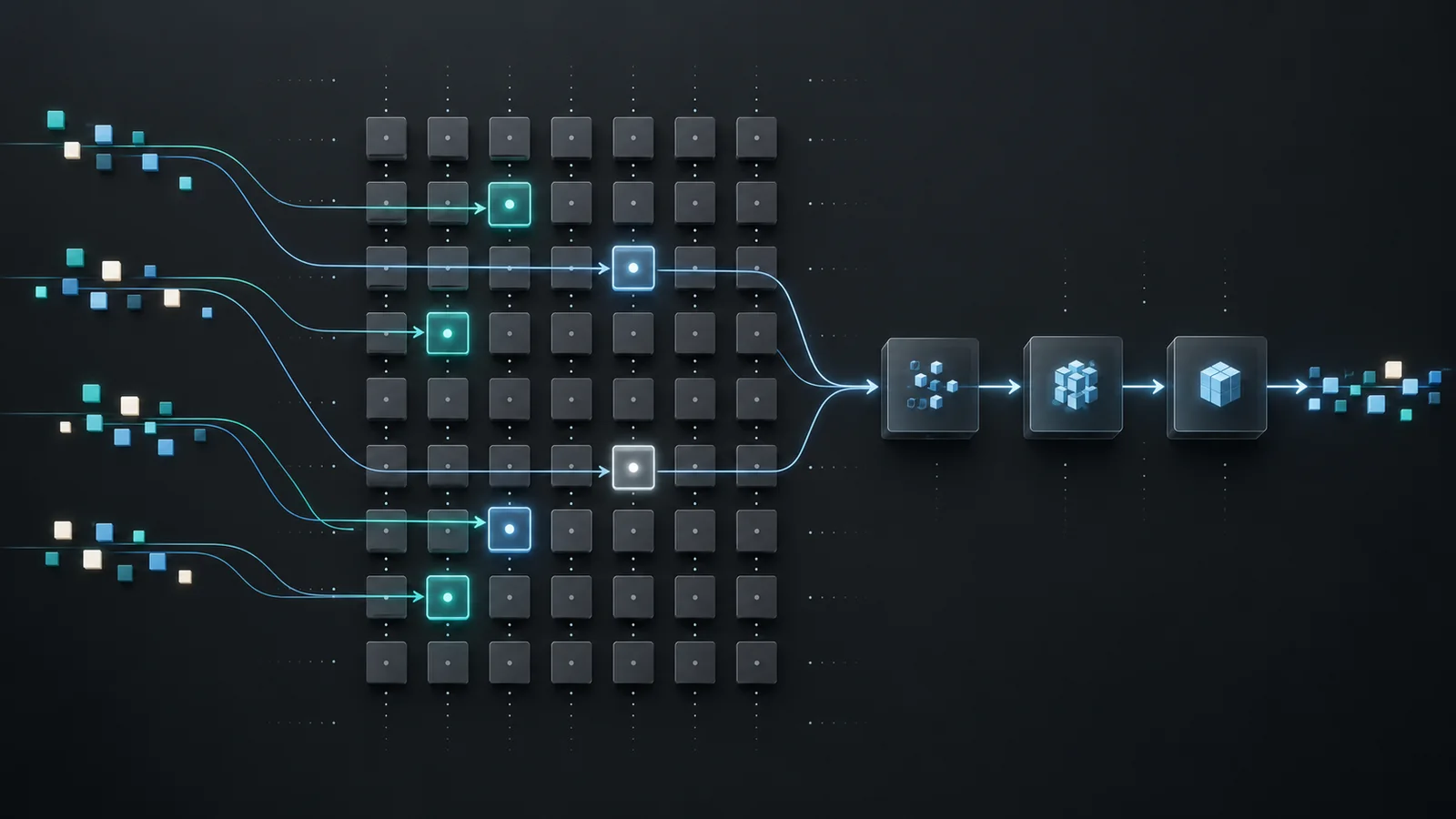
IFM says the releases share core architectural decisions, training methodology, interfaces, evaluation infrastructure and deployment tooling. The 375B model card describes a sparse mixture-of-experts system with 375 billion stored parameters but 23 billion active for each token. That design is intended to provide more capacity without using every parameter for every token. The card lists a native context window of 524,288 tokens from midtraining onward.
The 32B, 0.9B and 375B repositories identify those models as Apache-2.0 licensed. According to IFM, the 0.9B model uses a smaller vocabulary than the other five.
The performance figures remain issuer-reported. IFM says the 0.9B model scored 48.5 on AIME 2026, 79.9 on HumanEval+ and 37.4 on LiveCodeBench v6. It also presents the model ahead of selected same-scale reference models on several mathematics, coding and tool-use tests. For the 375B-A23B model, the institute claims results matching or exceeding open-weight mixture-of-experts models up to 2.6 times its size on selected agentic benchmarks, along with competitiveness against closed frontier systems. Its own table shows mixed results across benchmarks, and the opened evidence contains no independent reproduction of those results.
MBZUAI says a diffusion-distillation technique allows K2 Horizon to generate blocks of tokens in parallel, producing tokens about three times faster without reducing quality. The opened evidence does not independently reproduce that speed claim. The university also calls K2 Horizon the largest fully open AI model release in history, but the opened sources do not establish the comparison set needed to verify that market-positioning claim.
The launch announcement says MBZUAI released model weights, code, training data and methodology. Repository inventories dated September 10 and 11 show a more gradual rollout: the three opened model cards are available and list Apache-2.0 licenses, while code repositories and technical reports were still in progress. The 0.9B and 375B inventories also mark some expert checkpoints as pending, even as they list many pretraining, midtraining and final checkpoints as available.
More news
NVIDIA's compressed Puzzle-75B and audio-text Audex Nemotron models climb Hugging Face trending list
 Dmytro Spodarets·Jul 11, 2026
Google reports uneven public-health gains from Earth AI embeddings

Mistral launches Large 4 in public preview